Browns Canyon
National Monument
What’s In the Night Sky
Some stars, constellations and planets can be best viewed at different times of the year. Below you will find a short guide to help you get started. Visit one of these sites for more information on the night sky. Dark Sky International. Star Maps.
April:
New Moon: April 17
Full Moon(s): April 1
Planets: Venus is low in the West just after sundown in the constellation Taurus the Bull. Uranus is close to Venus however you will need a good pair of binoculars or a telescope to see it. Jupiter shines bright in the constellation Gemini the Twins.
Constellations: Hydra the Sea Serpent is the largest of the 88 constellations and stretches across the southern sky with Corvus the Crow and Crater the cup riding on the Serpents back. Leo is now high overhead and Bootes and Corona Borealis are both in the east.
April is your last opportunity to get a good look at the constellations Orion the Hunter and Taurus the Bull. They are both low to the west and will soon be setting.
During normal viewing hours, 9:00 pm to 12:00 am, the Milky Way is in the west low to the horizon and very dim. This due to the fact that we are looking directly away from the center of our galaxy. If you are looking for the magical bright photograph of the Milky Way you will need to wait until approximately 4:00 am.
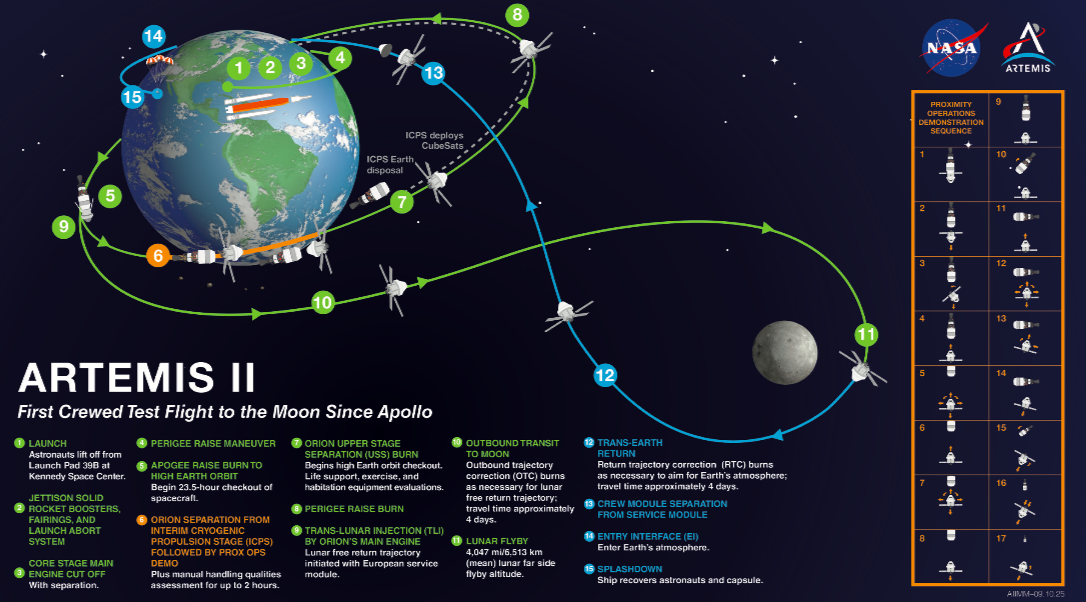
We all need to look up at the Moon this month because April is the planned launch date for NASA’s Artemis II mission which will take four astronauts around the Moon on a 10 day mission. The lunar flyby will be the first crewed mission of the Orion spacecraft and the first crewed mission to the Moon since Apollo 17 landed two astronauts on the surface in 1972. So no matter where you are, look up at the Moon at least once this month.
May:
New Moon: May 16
Full Moons: May 1 and May 31
Two full moons this month. The first full moon on May 1 is known as the Flower Moon. The second full moon falls on May 30-31 and so will be a Blue Moon. A calendar-month Blue Moon happens when two full moons fall within a single calendar month. The time between one full moon and the next is close to the length of a calendar month. So the only time one month can have two full moons is when the first full moon happens in the first few days of the month. This happens every two to three years.
Planets: Venus is low in the west just after sundown in the constellation Taurus the Bull. Jupiter is just above Venus in the constellation Gemini the Twins.
Constellations: Hydra the Sea Serpent, the the largest of the 88 constellations and stretches across, the southern sky, with Corvus the Crow and Crater the cup riding on the Serpents back. Bootes the Herdsman is high over head and Hercules is a bit to the East. Leo is now is the west.
Leo the Lion is a predominate sight for stargazers. Leo’s distinct forward sickle or “reverse question mark”, is easy to spot in the night sky. One way to locate Leo is to find the Big Dipper and imagine poking a hole in the bottom of the dipper. The water that would fall out of the dipper would fall onto the star Regulus, which is the bright star that makes the “period” of the reverse question mark.
During normal viewing hours, 9:00 pm to 12:00 am, the Milky Way is in the west low to the horizon and very dim. If you are looking for the magical bright photograph of the Milky Way you will need to wait until approximately 2:00 am and look into the east.
June:
Full Moon: June 29
New Moon: June 14
Planets: Venus shines bright low to the western horizon in the constellation Cancer the crab. Jupiter also shines bright just below Venus in the west in Gemini the Twins. Mercury also in Gemini can be observed below Jupiter just after sunset. A pair of binoculars will be very helpful to make out Mercury. It will look like a small dim star.
Constellations: The asterism the Big Dipper in the constellation Ursa Major The Big Bear can be observed high overhead in the sky. If you are from the United Kingdom you will know this asterism as The Plow. If you are from Germany, Sweden or other European Countries you will know the asterism as The Wagon. Here in the United States we call it The Big Dipper. If you are from the USA see if you can imagine a field plow or a wagon being pulled by horses.
With a pair of binoculars look at the second star from the end of the handle at the bend of the Dipper. This star is named Mizar, you should be able to make out it’s twin Alcor.