October begins in the waning phase of the lunar cycle, leading up to a new moon on October 10th. That creates dark skies in the early part of the month, which is ideal for viewing deep-sky targets and meteor showers. Near the end of the month, the full Hunter’s Moon will brighten the night sky, offering a striking view while reducing the visibility of fainter celestial objects. It’s best to plan your stargazing sessions around these lunar phases to ensure you make the most of nights under the stars.
October offers excellent planetary viewing, with most of the major planets visible at some point during the month. Venus and Mercury will make a brief appearance in the early half of the month, stay low in the evening sky, making them difficult to observe through a telescope.
New Moon: October 10
Full Moon: October 25, Hunters Moon
Planets:
October is Saturn month. Saturn will be visible in the east within the constellation Cetus very close to Neptune. You will need some good binoculars or a telescope to observe Neptune.
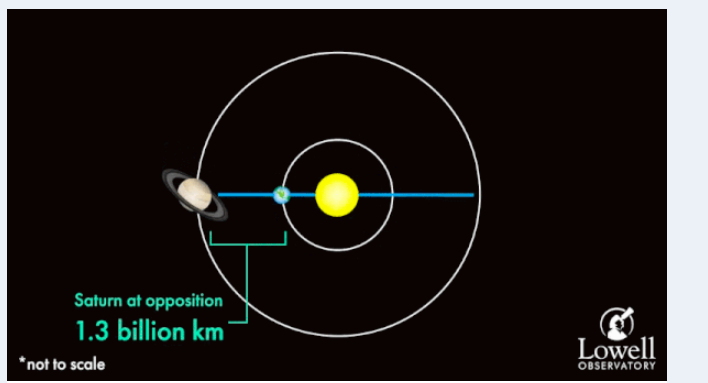
On October 4th, Saturn will be at opposition, making it the best time to view the planet through a telescope. Opposition occurs when Saturn is directly opposite the Sun in the sky, meaning it will rise shortly after sunset and remain visible all night long. Saturn will remain a great target for observation throughout October and the rest of the year. The best time to view Saturn during the opposition is around midnight, when it is highest in the sky and atmospheric distortion is minimized.
Opposition is when the Earth goes between the Sun and Saturn and occurs once a year. This occurs yearly because the Earth takes a year to orbit the Sun, while Saturn takes nearly 30 years. See the diagram below.
The rings of Saturn will appear to brighten due to a phenomenon know as the opposition effect.
Constellations: The famous asterism, the Summer Triangle is still visible high overhead throughout October but is beginning to set in the west.. Three bright stars make up the Summer Triangle. They are the brightest stars in three separate constellations and are named Deneb in the constellation Cygnus the Swan, Vega, in the constellation Lyra the Harp and Altair, in the constellation Aquila the Eagle.
Low along the horizon and to the southwest look for the constellation Sagittarius, the Archer. The nick name for the constellation is the Tea Pot as the stars appear to from the shape of a tea pot with the Milky Way pouring out of the spout. Once you find the spout of the tea pot in the western region of Sagittarius you will be looking towards to center or the galactic core of the Milky Way Galaxy. This area contains millions of stars and the most abundant and wide-ranging collection of deep sky objects in the sky.
The Milky Way: Milky Way viewing season is still in full swing and can be observed directly over head. Cygnus appears to be flying through the Milky Way flying east to southwest. During clear dark skies during September, you can see rich star fields with your binoculars throughout the Milky Way.
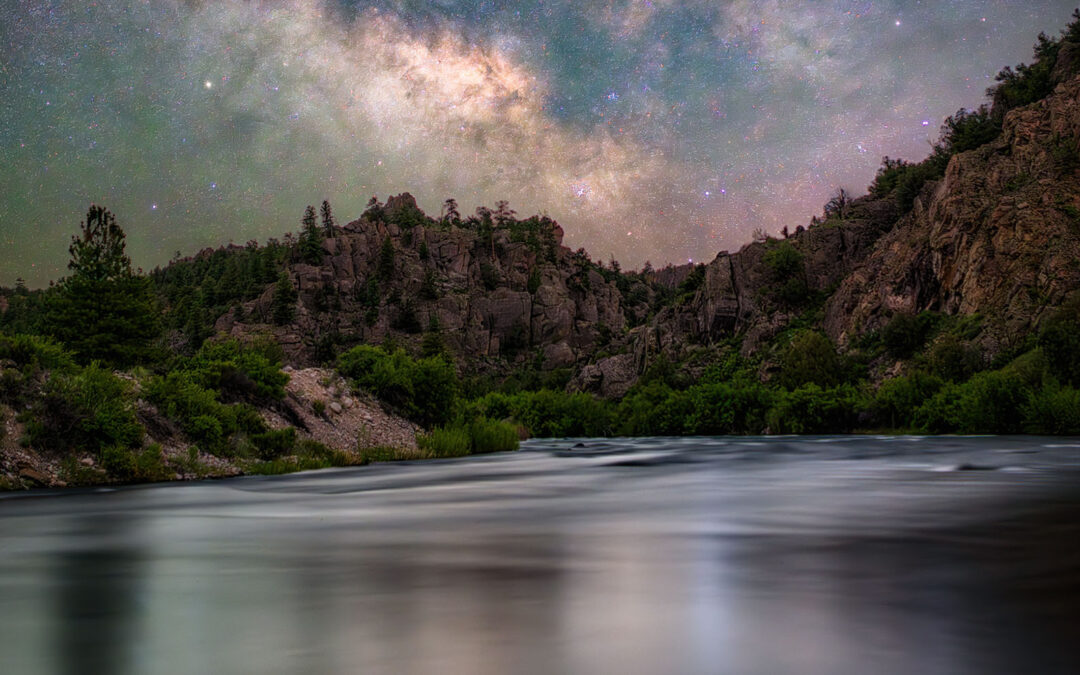
Keeping your eyes dark-adapted is especially important if you want to not only see the haze of the Milky Way, but also the dark lane cutting into that haze, stretching from the Summer Triangle to Sagittarius. This dark detail is known as the Great Rift, and is seen more readily in very dark skies, especially dark, dry skies as found here in the Monument. What exactly is the Great Rift? You are looking at massive clouds of galactic dust lying between Earth and the interior of the Milky Way.
Meteor Showers
October is a great month for meteor showers, with two notable events lighting up the night sky: the Draconids and Orionids. Both event will offer excellent opportunities to catch a fiery celestial display. Check out the details below!
DRACONID METEOR SHOWER: OCTOBER 8
The Draconid meteor shower peaks on the night of October 8th, just two days before new moon, which will provide excellent viewing conditions. While this shower is usually modest, producing around 10-15 meteors per hour at its peak, it has occasionally surprised observers with sudden outbursts.
To catch this shower, look between the constellations Hercules and Draco, just below the bright star Vega in the northern sky during the night of October 8th.
ORIONID METEOR SHOWER: OCTOBER 21–22
The Orionid meteor shower is a yearly event caused by the debris left behind by Halley’s Comet. Lasting approximately 40 days in total, this shower will peak on the nights of October 21–22th. Under ideal viewing conditions, observers can expect to catch up to 20 meteors streaking across the night sky every hour, with the best viewing window occurring after midnight and lasting until the first light of dusk in the early morning hours of the 22nd.
Links:
Dark Sky International
https://darksky.org/